Off Topic Lecture Series (2025-ongoing)
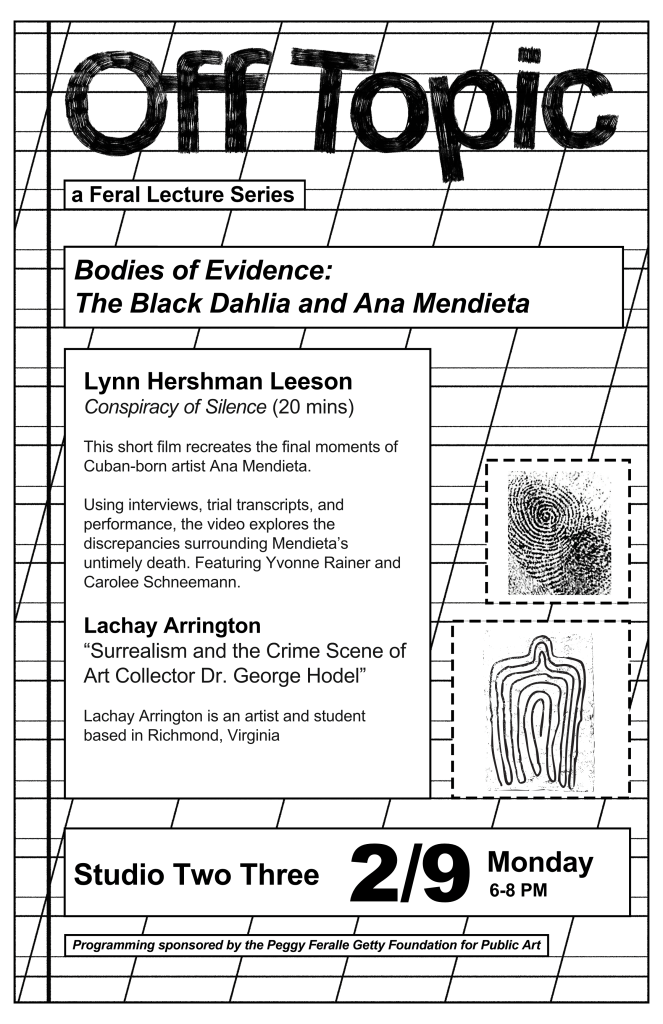
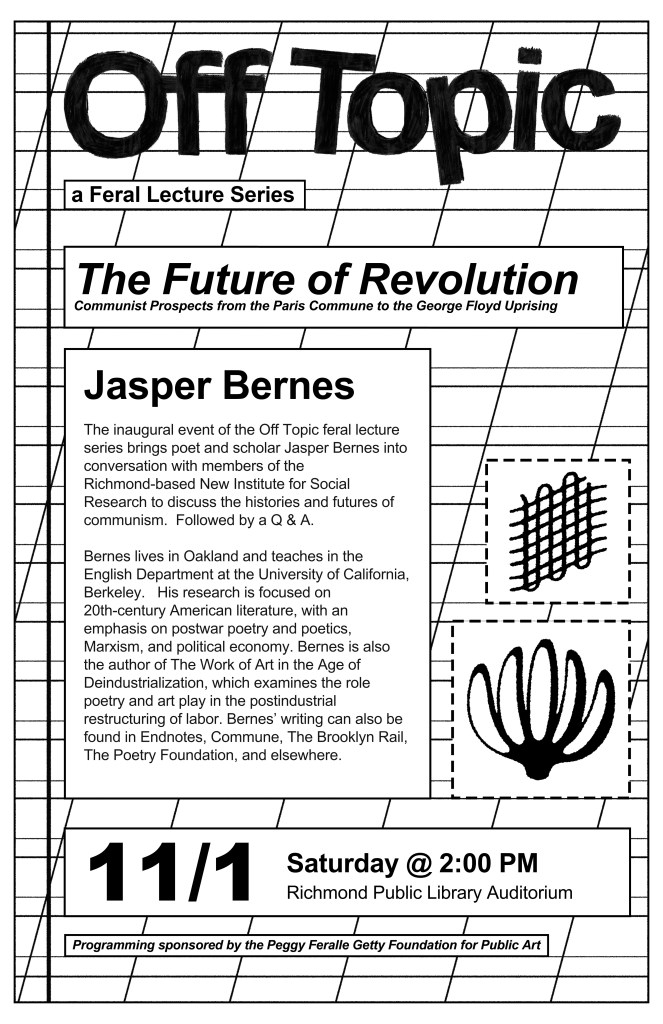
Collaborating with the artist and archivist Taylor Moorman, Off Topic is an ongoing lecture series committed to the work of creators dealing in new and unconventional topics.
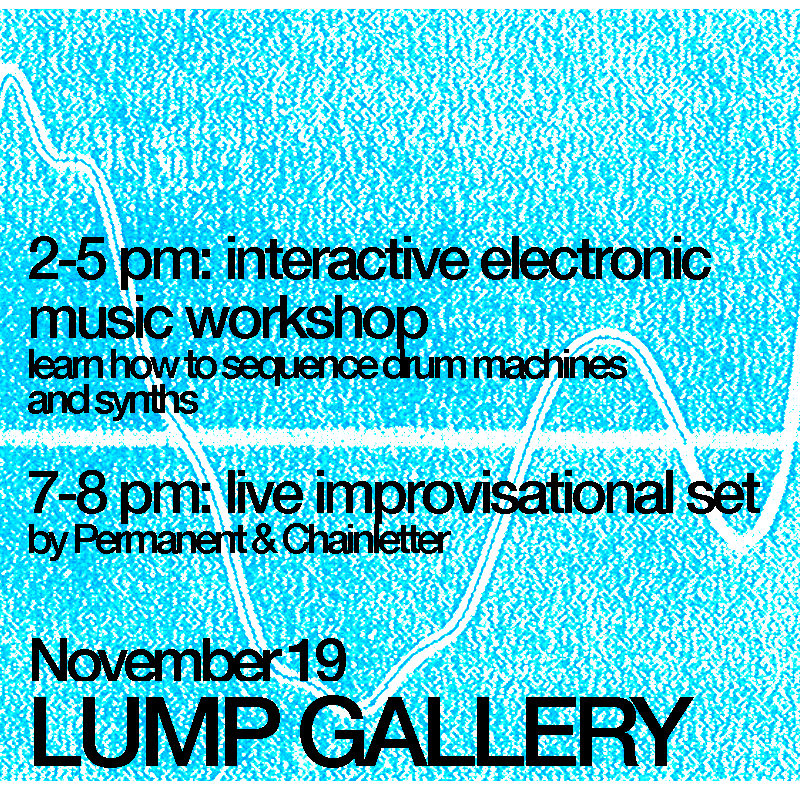
Interactive Electronic Music Workshop (2022)
The artist Chainletter (aka KC) and I provided one-on-one tutoring teaching community members how to program midi and make their own melodies and beats using hardware synthesizers and drum-machines.
Teaching
Be it the first or the last art history they ever take, my goal is that each student registered for my class complete it having mastered a set of methodologies and a vocabulary that empowers them to engage responsibly and critically with art and visual culture. My priorities as a professor of art history are student engagement and knowledge retention through discussion, demonstration, and active learning, regularly-scheduled, low-stakes assignments to gage student comprehension and provide feedback, and self-directed projects to spur inquiry and risk-taking.
Discussion and Demonstration
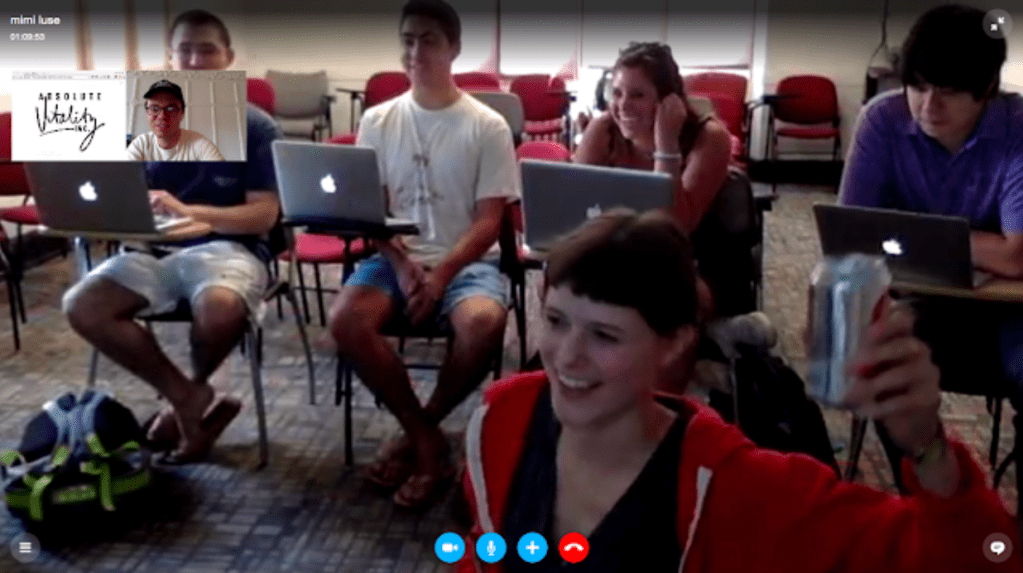
While some students learn well from lectures, I have found that others learn best when they are permitted to repeat what they’ve read or heard in their own words. Discussion is therefore central to my class, which is not “lecture” based, but includes a mixture of lecturing and leading questions launched back at the students, whose participation is a mandatory part of their grade. Active participation not only helps the students feel more comfortable in the classroom environment over time but also helps with knowledge retention.
As for technical concepts, these are demonstrated by comparing slides on the PowerPoint, while trickier concepts and terms are drawn or spelled out on a dry-erase or blackboard. For example, when leading review sessions as a TA in my History of Impressionism class, I demonstrated painterly “scumbling” by using the dry-erase board. Visualizing the example in real-time helped students differentiate the radical differences between academic and an Impressionistic painting styles.
To relay trickier concepts, I have also found it helpful to use comparisons to concepts that students are already familiar with. Visual comparisons, a hallmark of art history, are also crucial to my powerpoint lectures, as are online interactive “timelines” (such as Timeline JS) which I use to provide students with a broader understanding ofhow Art History is organised (see below for more on the canon). I enjoy asking students to compare and contrast two images and I am also fond of comparative “lists” to help define concepts.
Knowledge Retention and Student Engagement through Active learning
In my Introduction to the History of Art from the Renaissance to World War II course, students were introduced to the concept of perspective by being asked to copy the outlines of a Byzantine icon and the sight lines on a painting from the high Renaissance. This kinesthetic activity helped non-artists literally “take up the brush” in the same way an artist might, underscoring the formal geometric differences between non-perspectival and a perspectival forms of representation.
As important parts of the art history field that not all students may have had the privilege of experiencing, I schedule museum visits whenever possible. While temporary exhibits often have an “argument” built into the show, asking students to pay attention to how the permanent collection is organized and displayed is a wonderful exercise, teaching students not only about the art works themselves but bringing institutional practices like acquisition and classification into question.
Another way of exposing students to art history as a broad and living field is by assigning a variety of genres of readings. I assign readings outside the textbook as often as possible, including academic journal articles and contemporary reporting on art. To expose the students to a variety of different “art writing” styles, at the beginning of the semester, I give a “free” reading assignment, asking students to read an article of their choosing from any of the library’s contemporary art periodicals and to provide a brief report on the genre of article, the subject, and the writer’s approach and tone. This brief analytical exercise allows students to familiarize themselves with contemporary art periodicals, while also exposing them to examples of “thick” description, ekphrasis, and the “language” of art writing.
Frequent Assessment to Gauge Progress and Provide Feedback
In addition to exposing students to the real-world “art world” through periodicals and museums, I encourage knowledge retention through regular, low-stakes assignments. In my experience as both a teacher and a student, I found that assigning very brief responses to homework readings were the best way to ensure students kept up with the readings. For example, in classes I’ve taken and taught at Duke, for each night of reading, students were asked to pose a single, synthetic question on the digital message boards on the Sakai interface. These questions are then drawn out in class discussion, allowing student curiosity and interest to guide the discussion, though not the course content. For my course, I provide the students with a very specific rubric for “posting” questions, including clear guidelines about what kinds of questions constitute valid academic inquiry and what kinds of questions do not (i.e. yes or no questions, or questions that can simply be “answered” by mining the text are not permitted). Alternatively, I have also assigned weekly “reading summaries,” which I find work just as well if not better, and have the benefit of providing good writing practice.
In addition to reading-response participation, in my Introduction course, I give a short “reading comprehension” quiz every week. Though the Sakai responses and the weekly quiz are both low-stakes assessments, they encourage students to read deeply, to process what they’ve learned, and to stay on schedule. Finally, they provide me with a way to assess student comprehension and progress, thereby allowing me to adapt my teaching schedule to address common problem areas.
Historiographical inquiry and Canon Formation
Considering that my own research looks explicitly at the problem of canon formation and politics during the Interwar period, I attempt to explain to my students that the syllabus I’ve put together is by no mean free of bias or exclusions.
However, when I taught the introductory survey, I switched from the traditional course plan to reflect the changing nature of art history as a discipline. I switched from Janson’s textbook on Western art and instead used the second half of Stockstad’s Art History, which does not exclude non-Western art movements. While I Maintained a linear chronology of Western art to assist student learning, In this class, I broke this canon up by inserting modules on non-Western art immediately prior to moments of influence and exchange. For example, before the class on Impressionism and Japonisme, I spent a class on Japanese art in the 19th century. Likewise, before my class on Venice in the Renaissance, I looked at Islamic architecture, and I included a class on modern African tribal sculptures and masks just prior to my class on Cubism. In this way, I exposed students to key-non Western art forms without having to sacrifice the pedagogical utility granted in the chronological framework of the history of Western art.
Questioning the western canon was equally important for the modernism survey I taught, Modern Art in Europe: 1900-1945. The last two units of this course were devoted to case studies of modern art in Brazil and India, looking at the work of Tarsila do Amaral and Gagendranath Tagore, two painters who each in very different ways to sought to negotiate between the idioms of “international” European modernism and local traditions, all the while critiquing European colonialism they experienced first hand.
Self-Directed Inquiry, Digital Pedagogy
At the end of my classes, students are assigned a research project which can either take the form of a paper or an online exhibition (see below for more). The paper is an opportunity for the student to become an “expert” on a certain subject, or to explore a challenging topic. Critical inquiry self-directed projects For my introduction to the History of Art class, I used the an Ubuntu/ Amazon virtual server to create an Omeka-powered exhibit site that featured Neatline, the plug-in for interactive mapping and time-lines. Students populate the site themselves, uploading one image for each reading, and placing it on the world map in Neatline. By the end of the semester, students have access to a large data set of objects which they can then curate their own exhibit and write a short exhibition catalogue entry. Alternatively, they may write a 5-7 page traditional art history paper.
In conclusion, through student engagement and participation, active learning, and tools of digital pedagogy, my goal as an art history teacher is to engage students, and relay to them the importance of art and art history and visual culture as important lenses of inquiry through which they can better understand world culture and history.
COURSES TAUGHT:
ARTH 280: Introduction to Modern Art 1900-1945
ARTH 209-1 / ECON 390: Art, Money and Labor: 1850–Today
ARTH 102D-01: Introduction to Art History; Renaissance to WWII

